
We're seeing increased questions from travelers and Executive Assistants about airline stability and potential disruption. Here's what's happening, what it means, and how to manage it.
What is going on
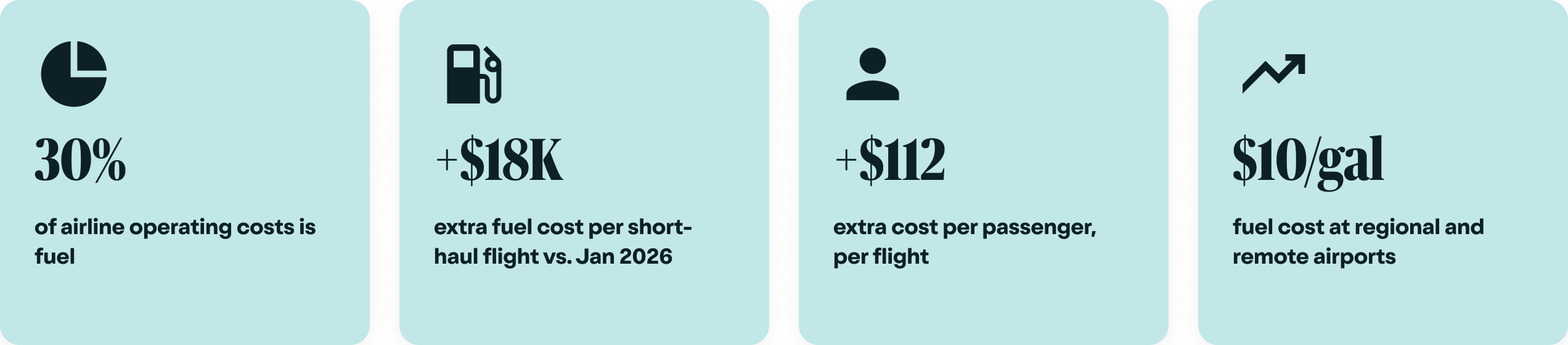
Jet fuel prices have risen sharply due to geopolitical tensions in the Middle East and reduced fuel flow through key global shipping routes. This is putting pressure on airlines worldwide. Fuel now represents roughly 30% of airline operating costs, and at $10 per gallon at regional and remote airports, the strain on thinner routes is acute.
At the same time, weaker carriers are starting to feel it first. Spirit Airlines has ceased operations. While that's an extreme case, it highlights a broader trend: not all airlines are equally equipped to absorb cost shocks.
What's the impact
Globally
- Higher airfares across most markets
- Fuller flights with less flexibility
- Airlines reducing frequency on select routes
- Schedule changes happening closer to departure
By region
North America: Loss of low-cost capacity following Spirit's shutdown. Expect tighter availability and higher pricing on U.S., Caribbean, and leisure routes.
Europe: High exposure to imported fuel. Airlines are proactively consolidating schedules. Some summer capacity reductions are expected.
Asia Pacific: Early signs of fuel-driven schedule adjustments. Price sensitivity in the region is accelerating fare increases and route changes.
Middle East and Africa: Fuel supply pressure and airspace complexity may lead to longer routings and higher operating costs. Some routes may be adjusted or reduced.
Latin America and Caribbean: Combined impact of global fuel prices and local supply constraints. Some destinations, including parts of the Caribbean, carry higher disruption risk.
Why low-cost carriers carry more risk
Important: Airline risk is not equal. Even if your corporate program uses major carriers, your travelers are still exposed through personal travel. Low-cost and ultra-low-cost carriers carry higher risk in this environment.
These airlines operate with thin margins, limited cash buffers, fewer partner airlines, and smaller networks. When disruption happens, they have fewer recovery options, meaning more last-minute cancellations, fewer rebooking alternatives, and greater risk of extended delays.
A single short-haul flight now costs approximately $18,000 more to fuel than it did at the start of the year, or over $112 more per passenger, per flight. A personal trip booked on a low-cost carrier carries the same exposure, and without the protection of a corporate program, the recovery falls entirely on the individual traveler.

Advice to travelers and EAs
- Book earlier than usual, especially for peak travel
- Book through your corporate travel program to access negotiated fares and preferred vendor pricing
- Avoid tight connections and same-day critical arrivals
- Reconfirm flights 24 to 72 hours before departure
- Build buffer time between personal and business travel
- Ensure traveler contact details are up to date for alerts
- For higher-risk itineraries, consider travel insurance that includes disruption coverage
- Prioritize airlines with strong networks and alliance partners
Guidance for program owners
- Expect continued fare pressure in the near term
- Reinforce preferred carrier strategies where reliability matters
- Educate travelers on the risk of booking outside the program, especially with low-cost carriers
- Encourage earlier booking behavior to secure availability and pricing
- Work with your travel partner to monitor route-level risks and traveler exposure
The reality
This is not a system-wide shutdown. Travel continues to operate. But the margin for error is thinner.
Choosing the right airline, building in time, and staying proactive will make the difference between a smooth trip and a disrupted one.
We're monitoring this closely and will continue to guide you as conditions evolve.