01 / Photography and possibility
When the door opened.
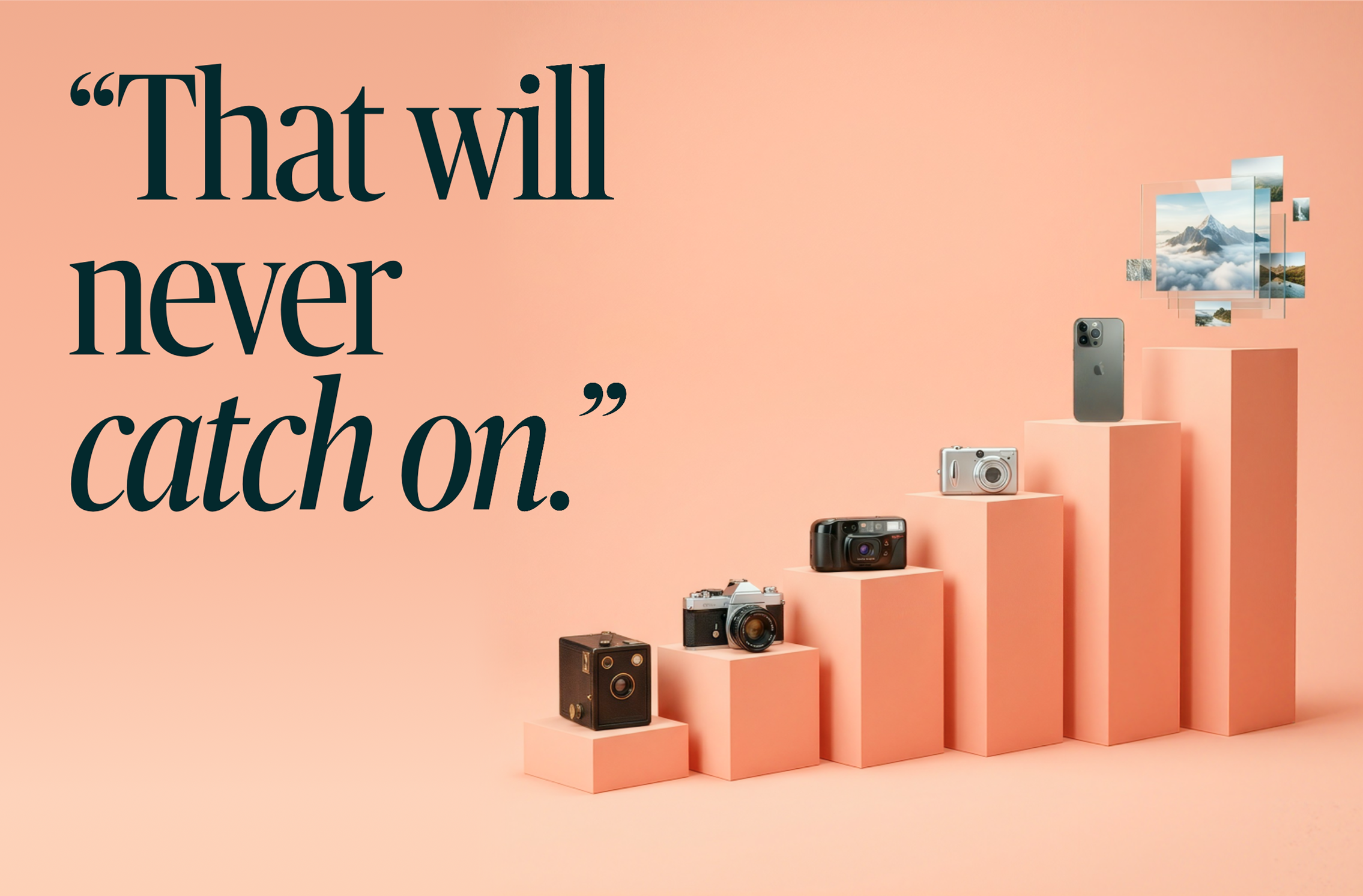
In 1900, Kodak introduced a camera that cost $1. The Brownie did not invent photography. It did something arguably more disruptive: it made taking pictures affordable for far more people. A small box had opened the door to a much larger crowd, which is often where both the fun and the objections begin.
The objections had, in fact, arrived before the Brownie. As portable cameras spread, enthusiastic photographers earned the delightful name “Kodak fiends.” Newspapers warned people to beware of cameras, while also finding photographs rather useful for selling newspapers. There were genuine concerns about privacy and people losing control of their own images. But there was also the uncomfortable discovery that a capability once largely reserved for specialists was becoming available to almost anyone. The public had acquired a new tool, and the public was not waiting for everyone to feel comfortable about it.
For much of the 20th century, taking the photograph was only the beginning. You still had to finish the roll, take it somewhere to be developed, wait, then go back to collect an envelope of printed photos. Remember opening it? That first shuffle through the glossy prints, looking for the moment you hoped you had caught. A holiday, a birthday, a face you loved. There it was. Or perhaps there it wasn’t.
Photography kept giving us something new to get excited about. Colour. Different cameras, different film, different print sizes. Think of the school portraits and all those choices. “Do you want a 5x8 or a 9x13?” Something for the frame, something for the grandparents. And passport photos: another reason to go somewhere and sit in front of a camera. These changes mattered. But that familiar journey from a roll of film to an envelope of photographs carried on for decades.
Kodak built a digital camera prototype in 1975, a full 75 years after the Brownie. It would take many more years before digital cameras became everyday consumer products. That distinction matters. Inventing something and having millions of people discover what to do with it are 2 different chapters. Most of us were still dropping off our film and waiting to see what came back.
Then, eventually, we could look straight away. Had we captured a beautiful family moment or 12 people blinking? We could check while everyone was still there, and try again. We still wanted to hold on to the memory. But the waiting, the return trip, the surprise inside the envelope: suddenly, we had another choice.
“Inventing something and having millions of people discover what to do with it are 2 different chapters.”
02 / The cost of holding on
“How tightly are we holding on?”
And here is the part that makes me pause. Kodak helped invent the very technology that would unsettle its world. It went on to make digital cameras, too. Yet having that knowledge inside the company did not spare it from bankruptcy in 2012. Imagine that. You can help create the future and still struggle to find your place in it.
Kodak. Nokia. Blockbuster. Familiar names, once woven into the ordinary rhythm of our lives. Their stories are different, and each made attempts to adapt. But they leave me with an uncomfortable question: “How tightly are we holding on to the way things have always worked?”
I understand the pull. There are livelihoods, investments and years of hard-earned experience tied up in a successful business. Letting go of something that has served you well can feel terribly risky. But customers keep discovering new possibilities. They wanted the photograph, the conversation, the movie. Their loyalty to the familiar way of getting it could change.
That is something I have to remember as a leader. When someone brings forward an unfamiliar idea, do we make room to explore it? Can we hear the possibility before we start explaining all the reasons it will never work?
“You can help create the future and still struggle to find your place in it.”
03 / From typing to publishing
More than a better typewriter.
Meanwhile, another transformation was happening on our desks. Think about the journey from the clatter of a typewriter to word processing and the personal computer. With a conventional typewriter, “Could you move that paragraph?” was not a small request. It could mean retyping the page, accompanied by a few words that were not intended for the final draft. Word processing let you edit on a screen, save your work and return to it without starting again. The ability to change your mind had become considerably less expensive.
But the personal computer was much more than a typewriter with better manners. When IBM introduced its PC in 1981, word processing and spreadsheets were among its applications. The same machine could help you write a letter or work through a budget. You did not need to understand how to build a computer before discovering what you could accomplish with one. That is the change I find so interesting: a powerful tool becoming something people could use directly in their own work.
And did everyone immediately abandon their familiar ways? Here is a detail I love. When TIME named the computer its 1982 “Machine of the Year,” the magazine revealed that the writer of its main story had produced it on a 15-year-old Royal typewriter. The future was on the cover. The typewriter was still on the desk. People do not adopt a new way of doing things on a synchronized schedule.
Then the possibilities expanded again. In 1985, PageMaker, alongside the Macintosh and Apple’s LaserWriter, helped bring desktop publishing to life. A computer was not simply where you typed the words anymore. You could arrange the page, combine text and graphics, and produce something that looked ready to publish. The desk was becoming a small publishing operation. Who could have looked at a typewriter and confidently described everything that would eventually take its place?
That is why I hesitate when someone judges a new technology only by the task it first appears to replace. Looking at a personal computer and seeing only a more complicated typewriter would have missed rather a lot. I wonder whether we sometimes do the same with AI. We try it on an email, decide whether we like the wording and imagine we have assessed its possibilities. Have we? Or have we found the first familiar thing to do with something we are only beginning to understand?
“The future was on the cover. The typewriter was still on the desk.”
04 / Predictions and persistence
“That will never catch on.”
By the time newspapers began moving online, confident predictions were readily available. Apparently, watching the desk turn into a publishing operation had not cured us of knowing exactly what would never happen next. In a 1995 Newsweek essay, Clifford Stoll declared that “no online database will replace your daily newspaper.” He also dismissed the prospect of buying books and newspapers over the internet. To be fair, his concerns about unfiltered information and online hostility were perceptive. The problem was not that he asked difficult questions. It was that he treated some of the answers as settled.
Predicting the limitations of a technology has 1 unfortunate feature: someone can read your prediction and decide to solve precisely that problem. In January 1996, The New York Times began publishing daily on the web. The people building that service did not know exactly where it would lead either. They were making a bet that people would come online and that there would be something worth building when they did. One person’s reason to dismiss the future was another person’s reason to get to work.
Publishing had its own earlier experiments. In 1971, Michael Hart began what became Project Gutenberg with an electronic version of the Declaration of Independence. The idea of making books freely available electronically took years of work to develop. That is the part of invention we sometimes leave out: people keep working long after someone else has finished explaining why the idea will never catch on. Today, I can publish this article without owning a printing press. I still need something worth saying, and I still need your attention. Technology has not relieved me of either responsibility.
I have lived through enough versions of “the future” to have developed a certain affection for the argument. Satellite dishes, Blockbuster, streaming. Phone books, mobile phones, smartphones, with the fax machine screeching away somewhere in between. Each belonged to a world that felt normal while we were in it. I can appreciate the nostalgia of Blockbuster without feeling any particular loyalty to returning a plastic box. I wanted the movie. The delivery system was negotiable.
I did not need to predict the smartphone’s entire future before finding it useful. Nor did I need to understand every technical detail before learning something new. We sometimes talk about adaptation as though it requires a heroic reinvention of the self. Sometimes it begins with being curious enough to press a different button and humble enough to ask, “What did I just do?”
“One person’s reason to dismiss the future was another person’s reason to get to work.”
05 / Imagination at work
The imagination. The audacity!
Then there is The Jetsons, which first aired in 1962. More than 60 years ago. A cartoon was imagining a family surrounded by automated conveniences, flying cars and a robot housekeeper. It was entertainment, not an engineering schedule, but it gave people permission to imagine an everyday life quite different from their own. I like that. Imagination does not have to submit a business case before it gets started.
Tesla’s October 2026 Roadster demonstration, complete with thrusters and an aerial flip, belongs somewhere in that conversation. It was a demonstration vehicle, not an everyday flying car already arriving in customers’ driveways. Before anyone calls our office to arrange a flying airport transfer, there are still some details to work out. Is it practical? Will the promise become a useful product? Perfectly reasonable questions. I am interested in the fact that someone watched a car stay firmly on the ground and apparently considered that an unfinished project.
That is the quality I would hesitate to bet against. Human beings are remarkably unwilling to leave things alone. We invent something, get used to it, find it inconvenient and start again. Not every invention works. Not every invention deserves a place in our lives. We need judgment, boundaries and people who ask awkward questions. But does anyone seriously believe human curiosity will politely retire while we reach a comfortable consensus?
Which brings me to AI and the extraordinary certainty surrounding it. Some people insist it is overblown and they need not engage with it. Others speak as though humanity’s closing ceremony has already been scheduled. I have the same question for both: “How can you be so sure?” The history of photography does not prove that AI is harmless. That would be a lazy argument. But a frightening possibility is not the same thing as an inevitable outcome, any more than an exciting demonstration guarantees success. I want to hear the concerns. I also want to hear what we intend to do about them.
And while we are talking about invention, can we please widen the guest list? Yes, we marvel at people like Steve Jobs, Jeff Bezos and Elon Musk. The imagination. The audacity! But they are not the whole story. Think of all the people working on ways to make water cleaner, communication more accessible or an ordinary working day less frustrating. Some breakthroughs are spectacular. Others quietly make life better. Why should fame determine which ones we celebrate? You do not need a stage and a product launch to make a contribution worth noticing.
“You do not need a stage and a product launch to make a contribution worth noticing.”
06 / More hands, more possibility
“Could I build something for that?”
That wider guest list brings me back to the little Kodak camera. You did not have to understand the chemistry of photography to capture your child’s grin or a face you loved. There was still expertise behind the photograph. But more people could now decide what was worth capturing and press the shutter themselves.
I see a similar door opening with software and automation. For years, you could know exactly what was slowing you down and still depend on a specialist to build the solution. You lived with the frustration. Someone else held the tools. Now more of those tools are within reach of the people doing the work.
Think of the person copying the same information into 3 different places, day after day. They know where the time goes. They can feel the irritation before they open the file. Imagine that familiar sigh giving way to a different thought: “Could I build something that does this for me?”
“But someone will still have to fix it.” Yes. And that deserves an honest answer. An application that works in a demonstration still needs to prove itself in everyday use. We have to test it, look after it and know when to bring in someone with deeper expertise. Do you really need to have it all figured out before you begin?
The question I would ask is whether, once we include the testing, repairs and upkeep, we have made the work better. Does it save time? Can people rely on it? If it creates more trouble than it solves, we need to rethink it. Curiosity gets us started. Judgment helps us decide what deserves to stay.
And there is room here for people to work together: someone who knows the task inside out and someone who knows how to make the software dependable. More people can help shape the solution. That is the possibility I find so exciting, because at Encore, I have begun to see it for myself.
“Do you really need to have it all figured out before you begin?”
07 / The Encore experience
“Look what I built!”
Our story began with a very different need. Everyone went home on March 16, 2020. The following Wednesday, we started a company huddle. The pandemic had upended our plans, and we did not know what came next. Our thinking was simple: “We have to stay in touch. No one should be isolated.” We could not provide certainty. We could make sure we kept showing up for one another. More than 6 years later, we still meet every Wednesday at 4pm, with colleagues joining from 4 countries. We did not set out to create a lasting tradition. We responded to a human need and kept going.
Now those same huddles include something I certainly did not foresee in March 2020. Every week, colleagues show us a problem they have solved or a process they have improved using tools they built themselves. Many people outside our technology team had previously used AI for little more than polishing an email or doing some research. Then we gave them room to experiment.
They tried something. It did not quite do what they wanted. They adjusted it and tried again. A little more tinkering, a clearer explanation, another attempt. They knew the part of their work they would gladly wave goodbye to: that familiar task that made their shoulders drop before they had even begun. Could they build something to take it off their hands?
And then, there it was. An application taking over the very task they liked least. Watching it come together, you could almost imagine they had rubbed a lamp and out popped a genie, ready to grant that particular wish. Of course, there had been plenty of trying before the magic appeared. That makes the moment sweeter. “Look what I built!”
In roughly 4 months, we had 25 apps and an internal app store. It may be 30 by now. I hear plenty of excited chatter, and every week there is something new to show. What surprised me was how many people jumped in. They were not software developers. They knew their work, understood the frustrations and kept trying until an idea began to take shape.
Our apps still need to earn their place in the working day. We need to measure the gains, see what people use and improve what does not work. But something important has already happened: people who started with “Can you improve this email?” are now showing others what they can build. They did not need to predict the future before participating in it. They needed curiosity, support and permission to try.
Think about that progression. We came together because we needed support. Now we also come together to share what we are creating. Nobody could have handed us that exact roadmap in 2020. We took a useful step, then another, and possibilities emerged along the way. This does not tell me what every job will look like in 10 years. It does make me question anyone who confidently assumes that people will have nothing left to contribute. How much possibility do we miss when we decide too early what someone can and cannot do?
08 / Resilience and responsibility
What colour are your glasses?
For me, this is what resilience looks like in practice. It is not always a dramatic comeback, and it does not always mean returning to the life you had before. Sometimes it is asking for help, trying an unfamiliar tool or admitting that a process you have followed for years deserves another look. Sometimes the person who was unsure how to begin becomes the person showing others what is possible. We should make room for that kind of surprise.
Of course, perspective matters. What colour are your glasses? Looking through an optimistic lens does not make a real problem disappear. It leaves room for another question after you have identified it. What can we improve? Who understands this better than I do? What would happen if we tried? I have no interest in optimism that ignores consequences. I am equally unconvinced by pessimism that expects to be mistaken for wisdom simply because it predicts the worst.
“But what happens to me?” is a real question, not an objection to brush aside. People have different resources, responsibilities and opportunities. Not everyone sees a possibility at the same moment. As a leader, I have a responsibility to provide time, support and a genuine chance to learn. Telling someone to embrace change while giving them no room to do so is not leadership. It is an extra assignment. And asking someone to experiment means accepting that every experiment will not succeed.
09 / The infinite game
Keep becoming. Together.
You do not control everything that happens to you. Nobody does. But declining to make a decision does not prevent someone else from making decisions that affect you. When someone asks what to do next, my answer usually begins with other people. Get to know someone whose work you do not understand. Ask what makes their day difficult. Offer your help before announcing your expertise. Relationships give you insight. Insight gives you ideas. Ideas give you opportunities. You do not always see the opportunity before you begin. Sometimes you see it because you began.
Will all of this feel comfortable? Probably not. Being a beginner again takes some humility, especially when you have spent years becoming good at something. But comfort makes a rather demanding travel companion. It generally prefers that you stay exactly where you are. You can acknowledge the discomfort without allowing it to make every decision for you.
That is where the infinite game comes in for me. The next quarter matters, but it cannot be the limit of our imagination. We build the ability to adapt over years, through lasting relationships in which people help one another learn and contribute. We have a responsibility to make tomorrow a little better, not merely to protect yesterday’s way of doing things. When someone discovers a strength and uses it to help others, more than 1 person gains. That is a philosophy worth protecting while everything around it changes. The point is not to reach a future in which nothing ever unsettles us again. It is to keep becoming more capable of meeting what comes, together.
So, to those resisting everything and those announcing the end of everything, I would suggest leaving a little room for what has not been invented yet, including the contribution you have not discovered you can make. I do not know exactly where this journey leads. I would rather participate than wait for certainty, and I intend to enjoy the company along the way. Somewhere, someone is working on the next ridiculous idea. Before explaining why it will never work, I would quite like to meet them. And these days, there is a good chance I will, on a Wednesday at 4pm.
About Encore
At Encore Corporate Travel, we believe the best things happen when people care deeply, think differently, and have the courage to challenge what’s possible. We’re an independent, woman-owned travel management company built on relationships, curiosity, and the conviction that there’s always a better way.
For 40 years, our greatest strength has been our people. As technology evolves and our world changes, we’re finding new ways to scale what matters most: care. We believe the future is something we build together.