What Is a TMC — and Do You Actually Need One?

A travel management company (TMC) is a professional partner that runs a company's entire business travel program — handling booking, policy compliance, spend visibility, and 24/7 traveler support. Modern TMCs pair expert human agents with travel management software to deliver negotiated rates and corporate duty of care at scale.
If you've ever relied on a regular travel agent — the same kind that books vacations to Cancun — you may have already run into the limits: the agent is on vacation when you need a same-day change, refuses to handle a complex international exchange, or simply isn't available outside business hours. That model wasn't built for business.
Enter the Travel Management Company (TMC), a solution often misunderstood by newcomers to the corporate sector. Think of a TMC as an expert partner — a hybrid between a high-end concierge and a smart software system designed to enforce your specific spending rules automatically, with real human support available 24 hours a day, 7 days a week.

Transitioning to professional business travel management does more than simplify receipts. In practice, it transforms chaotic logistics into a streamlined process, recovering valuable hours that owners usually lose to administrative hurdles — and replacing the gaps left by a traditional travel agency that may not be reachable when it matters most.
This partnership unlocks "negotiated rates," a concept that functions much like a wholesale club membership. Because TMCs represent thousands of travelers, they leverage that combined volume to secure discounts with airlines and hotels that you simply cannot find on public booking sites. These corporate rates often include flexible cancellation policies, preferred room types, and added amenities such as breakfast, Wi-Fi, and parking — meaning you get more value for every dollar spent without scouring the web for coupons.
Switching from a basic corporate travel agency to a full-service TMC delivers three distinct advantages:
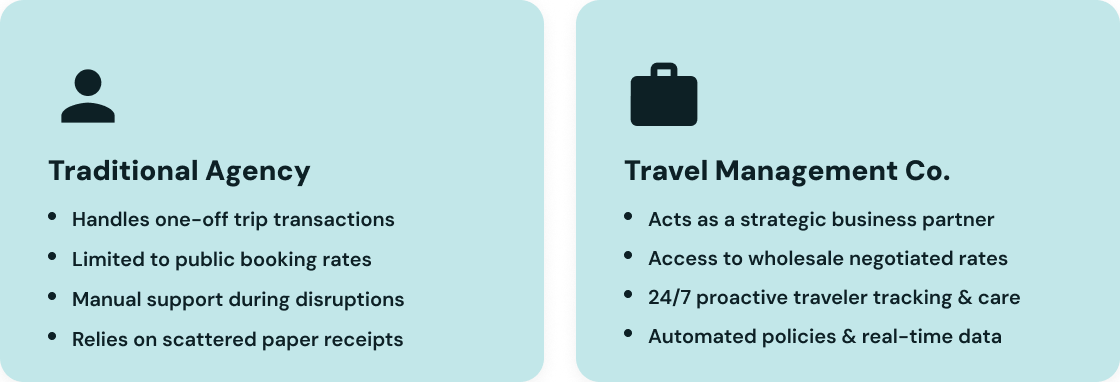
- Always-On, Full-Service Support: Traditional travel agencies typically operate during business hours and may decline complex requests — international exchanges, last-minute reroutes, or anything that falls outside their comfort zone. A TMC delivers true 24/7 priority support with agents trained to handle the full complexity of corporate travel, every day of the year.
- Corporate-Negotiated Rates and Amenities: Through corporate agreements, you access discounted pricing along with amenities not available on public sites — flexible cancellation, early check-in or check-out, complimentary breakfast, Wi-Fi, and parking. The savings extend beyond the nightly rate.
- Data Visibility: You move from chasing paper receipts to seeing a clear dashboard of exactly where your budget is going.
Securing better rates is a quick win, but the most profound savings often come from preventing bad bookings before they happen.

The Hidden Power of Guardrails: Automating Your Policy and Expenses
No business owner wants to play "bad cop" every time an employee expenses a luxury hotel suite. Instead of relying on a dusty PDF rulebook that nobody reads, modern TMCs embed your rules directly into the booking process. This shift to travel policy compliance automation ensures that budget limits are respected before a credit card is ever charged, rather than catching mistakes weeks later when the money is already gone.
Think of corporate travel online booking tools as a search engine with built-in bumper lanes. When your team logs in to book a flight, they see the same familiar interface they use for personal vacations, but the results are filtered. Options that fit your budget appear at the top, while out-of-policy choices are either hidden or flagged for approval. This approach creates a "set-and-forget" system where compliance happens naturally without micromanagement.
These digital boundaries can be customized to fit your specific company culture and budget needs:
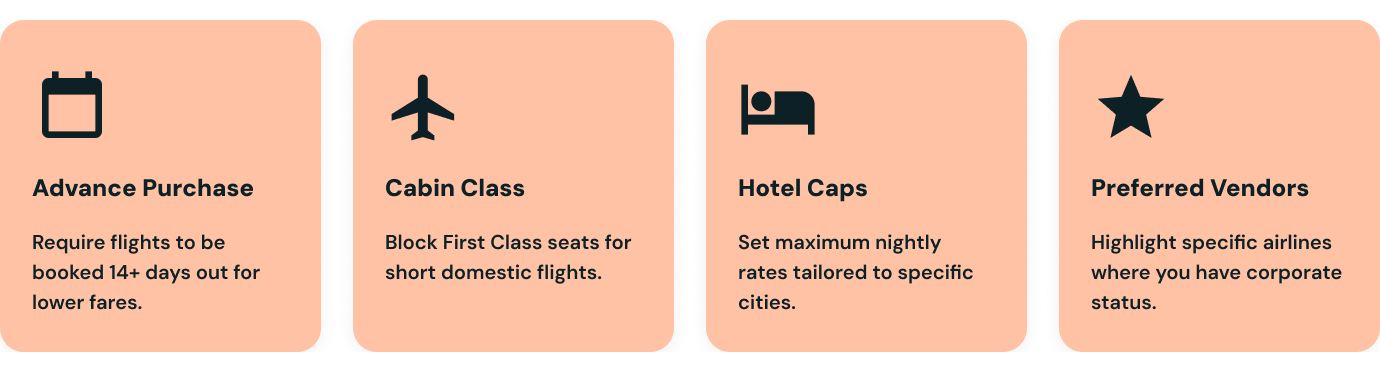
Beyond controlling costs upfront, these tools transform the backend of your business operations. By automating business travel expense management, receipts flow directly from the booking tool to your finance software, eliminating manual data entry errors. This integration gives you access to real-time travel data and reporting analytics, turning a chaotic pile of invoices into a clear view of exactly where your budget is going. With the financial side secured, you can focus on the critical human side: keeping your travelers safe.


From Chaos to Control: How to Choose Your First Corporate Travel Provider
Managing business travel shouldn’t mean juggling open tabs or worrying about where your employees are when plans change. The right Travel Management Company does more than book trips. It gives your organization the structure, visibility, and support needed to scale with confidence.
Moving away from manual booking transforms travel from an administrative burden into a strategic advantage. One where your team saves time, finance gains clarity, and leadership has the insight to make better decisions.
As you evaluate providers, it’s important to look beyond features and pricing. The right partner should feel like an extension of your team. Someone who understands your business, adapts as you grow, and shows up when it matters most.
The best travel programs aren’t built on tools alone. They’re built on partnership, trust, and the ability to deliver consistently over time.
For a deeper look at what to prioritize and how to evaluate your options, explore our Corporate Travel Buyer’s Guide. It’s designed to help you find a partner that brings not just control and visibility, but the confidence to scale your program with the business.
.png)



Frequently Asked Questions
What is a travel management company (TMC)?
A travel management company (TMC) is a specialized partner that runs every part of a company's business travel program, from booking flights and hotels to enforcing policy, controlling spend, and supporting travelers 24/7. Unlike a traditional travel agency that processes one trip at a time, a modern TMC pairs expert human agents with corporate travel technology to deliver negotiated rates, real-time visibility, and duty of care at scale.
What does a travel management company do?
A TMC centralizes corporate travel services across the full trip lifecycle: sourcing negotiated air, hotel, and car rates; automating travel policy compliance; tracking unused flight credits; simplifying expense reconciliation; and providing 24/7 traveler support during disruptions. Platforms like the Encore Platform unify booking, reporting, and risk management, so program managers see every trip, every traveler, and every dollar in one place.
Who needs a travel management company?
Most organizations outgrow DIY booking once travel spend reaches the six- to seven-figure range or travelers are spread across multiple teams and geographies. Telltale signs include finance chasing receipts, out-of-policy upgrades slipping through, unused flight credits expiring unclaimed, and no central way to locate travelers during a disruption. At that stage, a TMC delivers the structure, visibility, and corporate duty of care a growing program needs.
What is the difference between a travel management company and a travel agency?
A traditional travel agency books individual trips at publicly available rates. A travel management company manages an entire corporate travel program, combining negotiated corporate rates, automated policy enforcement, duty of care, data reporting, and dedicated account management under one roof. Put simply, a travel agency focuses on the transaction; a TMC focuses on the outcome: savings, safety, and a better traveler experience across the whole business.
What are the benefits of using a travel management company?
Businesses that move to a TMC typically save 10–20 percent through negotiated rates alone, while gaining automated policy compliance, consolidated reporting, and stronger corporate duty of care. With program management built around real people and real-time data, a TMC turns business travel from an administrative burden into a strategic advantage—protecting travelers, improving experience, and giving finance clean data it can trust.